
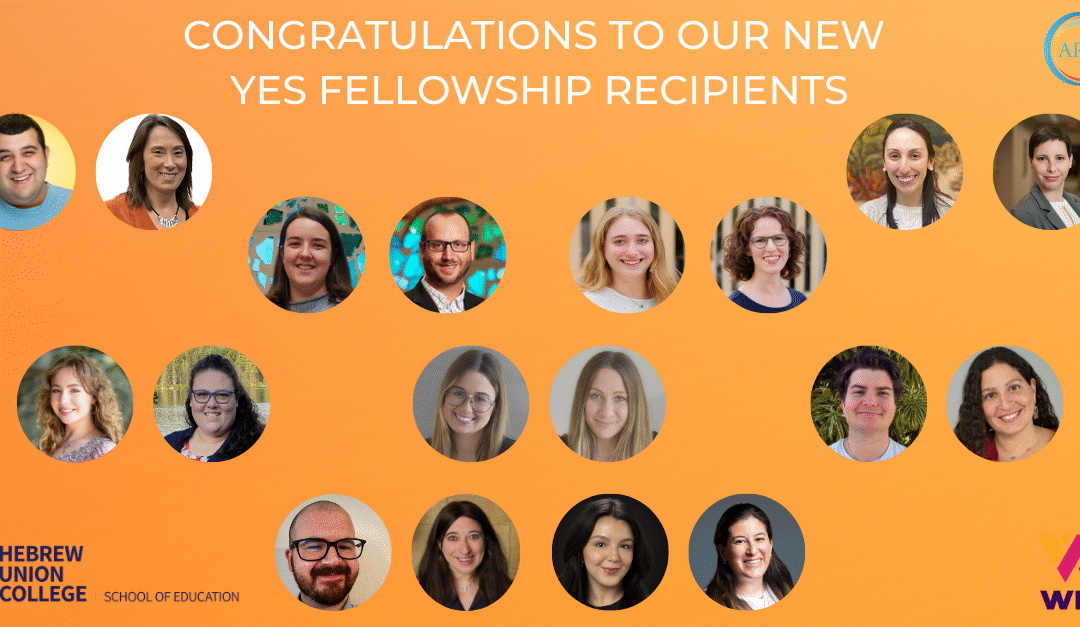
The challenges of recruiting and retaining well-trained Jewish educators in 2026 are well-documented and experienced across the ARJE network. This past Fall, we, along with our partners at Hebrew Union College School of Education, launched a new cohort – the YES Emerging Professionals Cohort. This learning opportunity would uniquely support educators beginning their careers AND their supervisors in growth, networking, and professional development. We are grateful to the Women of Reform Judaism (WRJ) YES (Youth, Education, Special Projects) Fund for supporting this new initiative aimed at strengthening the growth of emerging professionals in our field.
In December 2025, researcher Amanda Winer interviewed the emerging professionals and shared the following summaries of what the fellows identified as their hopes for participating in the program and their career and identity considerations.
- Emerging Professional Autonomy and Identity Formation:
Participants articulated a desire to develop greater professional independence and self-efficacy within the coming year. Central to this aspiration was the cultivation of self-advocacy skills, including the ability to negotiate roles and responsibilities, articulate professional boundaries, and assert individual needs within organizational structures. - Peer Networks as Sites of Professional and Emotional Support:
Across interviews, participants emphasized the critical role of peer relationships and cohort-based learning environments in fostering professional growth. These peer networks are described as essential spaces for emotional support, professional affirmation, and collaborative problem-solving, often compensating for perceived deficiencies in formal supervisory structures or peers within organizations. - Career Trajectories and Transitional Professional Identities:
Participants spoke extensively about the deeply personal nature of working in Jewish education. While many expressed commitments to remaining in the field in the long term, most simultaneously framed their current roles as transitional or timestamped, envisioning future movement into adjacent sectors such as camps or Hillel. - Programmatic Expertise and Educational Innovation:
The majority of participants identified their primary professional strengths as ideation and curriculum or program development. They articulated an expansive vision of Jewish education characterized by flexibility, relational engagement, and responsiveness to evolving communal needs, positioning innovation as both a personal competency and a necessary field-wide shift.
The Supervisors shared the following hopes and desired outcomes for their participation in the program through the application process.
- Building Supervisory & Leadership Skills
Supervisors are seeking to strengthen their own leadership capacity by developing concrete skills in supervision and mentorship. They want to grow in confidence as leaders, expand their professional “toolbox,” and learn practical tools and frameworks that will help them guide and support their staff more effectively. - Supporting Early-Career and Emerging Professionals
Many supervisors are working with staff in their first or second professional roles and are eager to support them well. They hope to become stronger mentors to young professionals, help lay a solid foundation for long-term careers in Jewish education, and guide their supervisees as they grow into skilled and committed educators and leaders. - Navigating Relationships & Communication
Supervisors are looking for guidance on the relational side of their work, including how to build stronger connections with their employees, provide meaningful feedback, and support staff through difficult situations. They want strategies for fostering reflective practice and maintaining healthy, growth-oriented supervisory relationships. - Understanding Generational Differences
Several supervisors expressed a desire to better understand and work with younger generations of professionals. They are seeking insight into perspectives that may differ from their own and tools for navigating generational dynamics in ways that promote mutual respect, positivity, and growth. - Shared Learning with Their Supervisee
A number of supervisors are excited about the opportunity to participate in learning alongside their supervisees. They see value in developing shared language, approaches, and expectations that can deepen their working relationships, strengthen team culture, and create a stronger foundation for collaboration. - Jewish Values & Educational Context
Supervisors want their growth as leaders to be grounded in Jewish values and the context of Jewish education. They are interested in learning tools and frameworks that support professional growth and reflective practice through a Jewish lens, with the ultimate goal of enriching the educational experiences they provide to their learners and families. - Community & Peer Learning
In addition to supporting their own teams, supervisors are eager to learn from one another. They value the opportunity to connect with colleagues across the field, share challenges and strategies, and gain perspective from peers who are navigating similar supervisory roles and institutional contexts.
The ARJE is grateful to Dr. Kathy Schwartz, RJE, Director of the Executive Master’s Program in Jewish Education at HUC, and Dr. Michelle Lynne-Sachs, who are facilitating the learning for the supervisees and supervisors, respectively. The cohort will meet seven times over the coming year and launch in January 2026.
YES Cohort participants include:
- Michael Einiger, Youth & Community Engagement Associate (Hillsborough NJ)
- Lisa Friedman, RJE, Director of Congregational Learning (Hillsborough, NJ)
- Emmie Weprin, Director of Youth Engagement (Evanston, IL)
- Lauren Reeves, Director of Lifelong Learning (Evanston, IL)
- Leila Gordon, Assistant Director of Religious Education (Washington, DC)
- Stephanie Tankel, RJE, Director of Lifelong Learning (Washington, DC)
- Shayna Lebowitz, Youth Engagement Specialist (Westport, CT)
- Katherine Cykman, Director of Experiential Education(Westport, CT)
- Matty Powell, Assistant Director of Congregational Learning (Milwaukee, WI)
- Brian Avner, RJE, Director of Congregational Learning (Milwaukee, WI)
- Ian Linder Sheldon, Youth Coordinator (Coral Gables, FL)
- Gaby Enser Tangir, Religious School Director (Coral Gables, FL)
- Annie Rosenthal, Youth Engagement Professional (Boca Raton, FL)
- Myriam Rofrano, Interim Director of Religious School (Boca Raton, FL)
- Gabe Komerofsky, Assistant Director of Youth Education and Programming (Austin, TX)
- Jordan Magidson, Director of Youth Education & Programming (Austin, TX)
- Eliana Hallegua, IACT/Engagement Coordinator (New York, NY)
- Rachel Barnehama, RJE, Senior Director of Engagement (New York, NY)